
Inchcleraun
The island of Inchcleraun, better known as the Quaker, is situated near the centre of Lough Ree. It is eleven miles, by river, from Athlone. It can also be reached from Barley Harbour Newtowncashel on the Longford shore, a distance of one mile. There are several landing places on both sides of the island. Its long axis lies north and south and measures slightly more than one mile. At its widest part it measures 600 yards. There is a much indented promontory on the north end of the island. This is called Muckinish (Island of the Pigs).
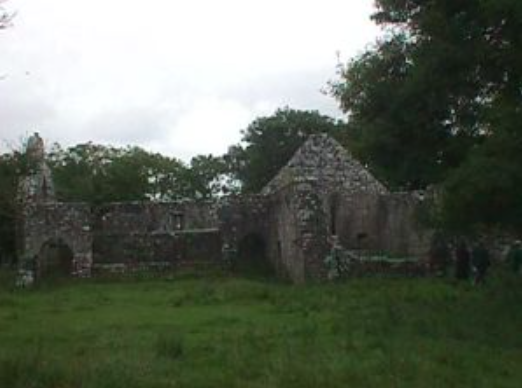
Inch Cleraun or Inis Clorthrin, is said to have been named after "Clorthrin,", sister of the famous Queen Maeve, who lived during the first century. She was of the Amazonion type, and is sometimes referred to as the "Boadicea of Ireland". Her husband was Ailill, King of Connacht. After he was killed in the battle Maeve retired to the island and erected a fortified garden called "Grianan Maeva", on the east shore. The English meaning of this is, "The beautiful sunny spot of Maeve".
The island was celebrated in Christian times as being the residence of St. Diarmid, or Dermot, the teacher of St. Ciaran, founder of Clonmacnoise, who lived about the year 500 A.D. It was repeatedly plundered and burned between 800 and 1300 A.D. It contains seven churches, the most remarkable is called the Clogas, or square belfry, which is attached to the main building. This is an unusual feature in that most churches of this era have round towers, which in every case with the exception of the one in Clonmacnoise, are separate from the main building. It is located on the north side of the island and is visible from the shoreline. There are six other churches within a cashel of stone and earth fortification. The smallest is Templedermot, evidently the primitive oratory of the founder and the name of largest church is Templemurry.
Teampall Diarmada
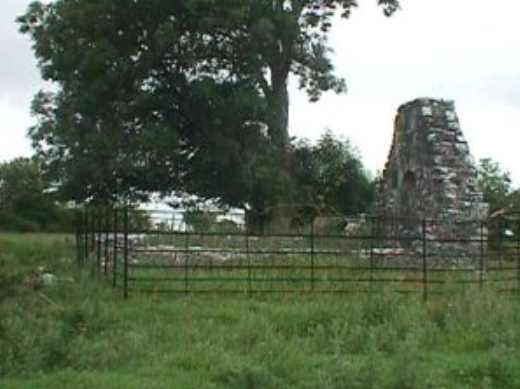
This is one of the diminutive buildings of the early Christians.
It still retains in what is left of it, some peculiar features.
The ends of the side walls project a foot and a half beyond the face of the gables, thus forming buttresses.
The measurement from one outer extreme to the other is only 14 feet.
The east window has disappeared, and there is no visible sign of an altar.
The doorway in the centre of the west end bears evidence of having been slightly disturbed.
The remnant of the gable over this door rises to a height of about 15 feet from the present groundline.
There is little doubt that this church once possessed a stone roof, although no vestige of it now exists.
Teampall Mór
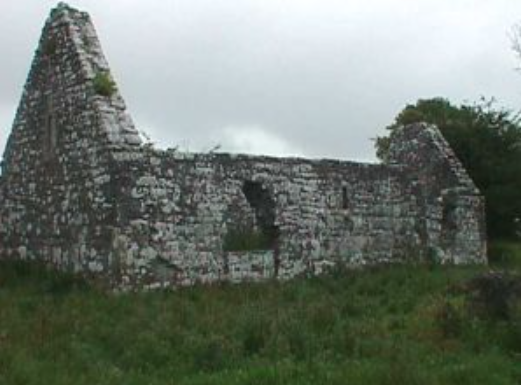
Within 12’ of teampul Diarmada, to the north, stands Teampul Mor. This monastery is the most important ruin on the island. The church consists of a single nave 47’ 7’’ inches by 21’ 5’’. The plain masonry walls rise to about 13’ and remain in reasonable condition. Two graceful recessed lancet windows can be found on the east.
The windows on the south side have the appearance of being a later addition. All traces of doors have vanished, but the opes, which have been arched and protected by the Board of Works, seem to indicate the position of a west door and an entrance on the north side to the cloister.
There is evidence that an upper chamber existed, covering the Chapter-house sacristy, and the east cloister, with the internal walls of the lower apartments forming support for its floor.
It is worthy of note that the interior walls of the church were once plastered. John O'Donovan, in a note preserved amongst the Ordnance Survey Letters, refers to this building as two churches. He considered the lower monastic apartments as one, and the vaulted sacristy as a ‘Deartheach’, possibly an internal timber structure.
This building is a fairly good example of the type of an early Christian churches in Ireland. The extreme dimensions of the rectangle being 23’ 8’’ by 15’ 8’’, the walls have crumbled down and now are only a few feet high, and have lost their distinctive features of detail except the east window, which is similar in construction to that of the Teampul Clogas. The interior arch of the east window is circular, built of four stones. The exterior has only two stones forming a pointed arch.
In this building we find the first church forming the chancel of a more extended structure the nave being a subsequent addition. The east window is relatively unharmed and closely follows those of the Clogas and the Church of the dead.
Underneath this window, stands the remains of an altar, rudely built of rubble work but minus the altar slab. The door in the south wall of the Nave has a circular moulding. The north door is only a gap. To the east of the chancel wall is a rough heap of broken masonry which is believed to have been a "saints bed". At the east end of the chancel church stands a large Irish Yew which overshadows the whole structure.
This church is situated a short distance to the south of the cluster of churches, and consists of four walls varying in height from 2 feet to 9 feet. It is entirely devoid of any worked detail.
The "altar" is composed of the remains of some finely worked thirteenth-century clustered columns, The building is more modern in appearance than any of the others, and is braoder and not as strongly built. It may have been the church of Saint Mary or the Church for the Women of the settlement, and entirely devoted to their use and used as a burial place for women only. At the north-west corner of this church is a more modern chamber with no visible entrance. Near this church, half buried with its face downward is a stone bearing incised on its surface a Celtic interlaced cross with an Irish inscription.
It is a rough irregular slab of sandstone grit, about 6 inches thick and about 26 inches by 21 inches in size.
Teampall Clogas
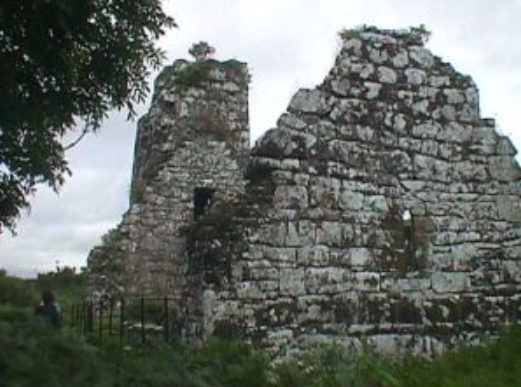
The Teampul Clogas stands isolated and lonely, crowning the highest point of the island.
It is remarkable for possessing a square tower at the west end which gives the church its name. On the plan the church is rectangular, being 34ft. 8ins. by 16ft. 8ins. The tower is square in plan and bonded into the old gable to which it has been placed as an addition, and was entered on the ground floor from the inside of the church by a square and poorly formed doorway.
The tower has no windows on the first or second floors, the doors serving both purposes, it has one window towards the west on the third floor, and one to the south on the fourth floor. In the south wall close to the east end is built a curious stone with a hole right through it large enough to allow the hand to pass. The church is not of a very early type and the stairway has certainly a post-Norman look about it.
INIS CHLOTHRANN
719 AD
St. Sionach of Innis Chlothrann died on the 20th day of April
769 AD
Curoi, the son of Alniadh, Abbot and Sage of Innis Chlothrann, and of Caill Fochladha in Meath died.
780 AD
Eochaidh, the son of Focartach, Abbot of Fochladha, and of Innis Chlothrann, died.
1010 AD
The men of Munster plundered Inis Clothrann and Inis Bo- finne
1050 AD
Inis Clothrann was plundered
1087 AD
The fleet of the men of Munster, with Mortog O' Brien, sailed on the Shannon to Lough Ree and plundered the islands of the lake
(inc. Inis Clothrann)
1136 AD
Hugh O' Flynn, the Bishop of Briefny,
died in Inis Clothrann
1141 AD
Gilla na naomh O' Farral, chief of the people of Annaly, the most prosperous man in Ireland, died at a great age and was buried at Inis Clothrann.
1150 AD
Morogh, the son of the above, the tower of splendour and nobility in East Connaught died in Inis CLothrann
1160 AD
Gilla na Naomh O' Duinn, Lecturer of Inis Clothrann, Professor of History and poetry sent his spirit to the Supreme Father amidst a choir of angles on the 17th day of December in the year of his 58th birthday
1167 AD
Kinneth o' Ketternaigh, Priest of Inis Clothrann died.
1168 AD
Dubhcobhlach, the daughter of O'Quinn, wife of Mac Corgamna, died and was interred in Inis Clothrann
1170 AD
Dermaot O' Braoin, Coarb of Comman, was chief senior of the east of Connaught,
died in inis Clothrann in the 95th year of his age.
1174 AD
Rory O' Carrol, Lord of Ely, was slain in the middle of Inis Clothrann
1189 AD
It was at Inis Clothrann on Lough Ree that the hostages of O' Connor Maonmoy were kept at the time.
1193 AD
Inis Clothrann was plundered by the sons of Costelloe and by the sons of Conor Moinmoy
1232 AD
Tiapraide O' Breen, Coarb of Saint Coman, an ecclesiastic learned in History and Law, died on his pilgrimage on the island of Inis Clothrann
1244 AD
Donagh, the son of Finghin, who was the grandson of Hugh, son of Torlogh O'Connor Bishop of Elphin, died the 23th of April on Innis Chlothrann,and was interred in the monastery of Boyle.